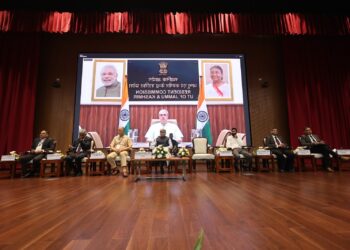
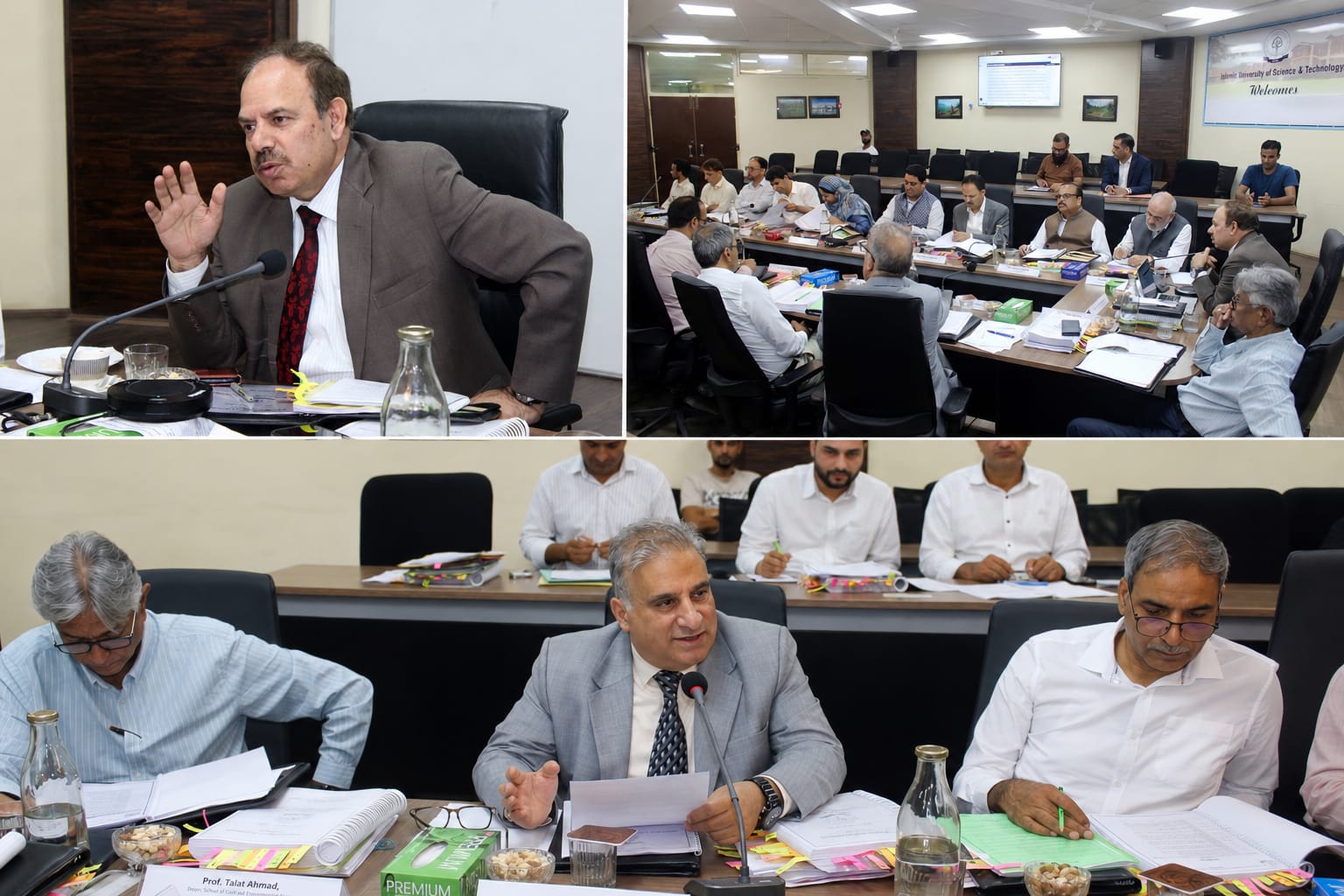

Awantipora, June 30: The Islamic University of Science and Technology convened the 11th Meeting of its Academic Council under the chairmanship of Vice Chancellor Prof. Shakil Ahmad Romshoo, with eminent academicians from across the country participating in deliberations on key academic initiatives, institutional priorities, and the University’s long-term growth strategy.
The meeting was chaired by Prof. Shakil Ahmad Romshoo Vice Chancellor, IUST, and attended by distinguished academicians and senior university functionaries, including Prof. Talat Ahmad, Former Vice Chancellor, University of Kashmir; Prof. Mehraj Ud Din Mir, Former Vice Chancellor, Central University of Kashmir; Prof. Mohammad Mubin, Vice Chancellor, Cluster University of Srinagar; Prof. Manzoor Ahmad Malik, Dean, School of Physical and Mathematical Sciences, University of Kashmir;
Prof. Ashok Aima, Former Vice Chancellor, Central University of Kashmir; Prof. Shobha Bagai, Professor, Cluster Innovation Centre, University of Delhi; Prof. Madhav Govind, Centre for Studies in Science Policy, School of Social Sciences, Jawaharlal Nehru University, New Delhi, Prof. Ranjan Rawal of CEPT University, Ahmedabad, Prof Sheikh Aijaz, Dean Academic Affairs, Registrar, Finance Officer, Dean Research, CoE, Deans of schools, Dean Outreach, Dean of Students, Chief Proctor, and In-charge Library.
At the outset, Prof. Romshoo shared a report on the University’s progress, informing the members about the various initiatives undertaken, achievements made, and future plans in the pipeline. Prof. Romshoo said, “IUST is committed to building a future-ready academic ecosystem that responds to the rapidly evolving landscape of higher education. The introduction of new-age academic programmes and emerging areas of study reflects our endeavour to equip students with relevant knowledge, contemporary skills, and the capacity to drive innovation in a knowledge-based economy.”
He further said, “The steady rise in student enrolment is a strong affirmation of the confidence reposed in the University. We remain equally committed to enhancing the quality of teaching and research, fostering interdisciplinary learning, and creating an enabling environment where every learner can realise his or her full potential.”
The meeting was coordinated by Dean Academic Affairs, Prof. Sheikh Aijaz, who presented the agenda. Speaking on the deliberations, he said, “The decisions taken by the Academic Council represent another significant step in broadening the University’s academic horizon. The emphasis on frontier disciplines, curriculum innovation, and academic flexibility is fully aligned with the aspirations of the National Education Policy and the evolving needs of society and industry.”
He added, “Alongside expanding academic opportunities, the University is continuously strengthening its academic governance, student-centric support mechanisms, and quality assurance processes to ensure a holistic learning experience that is both inclusive and relevant for Industry 4.0.”
The Council approved a series of significant academic initiatives aimed at strengthening IUST’s teaching, research, and innovation ecosystem. Among the major decisions was the establishment of a Centre of Excellence for Semiconductors and Quantum Materials, aligned with the Government of India’s Semiconductor Mission, to promote cutting-edge research, innovation, technology development, and capacity building in semiconductor sciences.
The Council also approved the introduction of B.Tech. in Cyber Security, M.A. in Mass Communication with AI, a five-year Integrated Law Programme, a Master’s Degree Programme in Medical Laboratory Science (MMLS), and the establishment of a Department of Earth Sciences, among other initiatives, thereby expanding the University’s academic footprint in emerging and strategically significant disciplines.