

Email: [email protected]
“Behind every cancer statistic is a human life—and behind every early diagnosis lies a chance to change its story.”
Cancer is no longer a distant health concern for Kashmir. It is a reality affecting families across the Valley, bringing emotional distress, financial challenges and uncertainty about the future. From the fear surrounding a new diagnosis to the difficult journey of treatment, cancer touches not only patients but entire families. Yet one important truth is often overlooked: awareness, prevention, timely diagnosis and appropriate treatment can make a meaningful difference. Kashmir needs to speak more openly about cancer, understand the risks supported by scientific evidence and ensure that people seek medical advice without unnecessary fear or delay.
The available figures underline the importance of this issue. During the period covered by reports published in February 2026, 25,621 cancer cases were reported in the Kashmir Division. Separately, estimates compiled under India’s National Cancer Registry Programme indicated that the annual number of cancer cases across the Union Territory of Jammu and Kashmir was estimated to rise from 13,060 in 2021 to 14,493 in 2025. These figures come from different reporting systems and should not be directly combined. They nevertheless highlight the importance of reliable cancer registration, prevention and access to care.
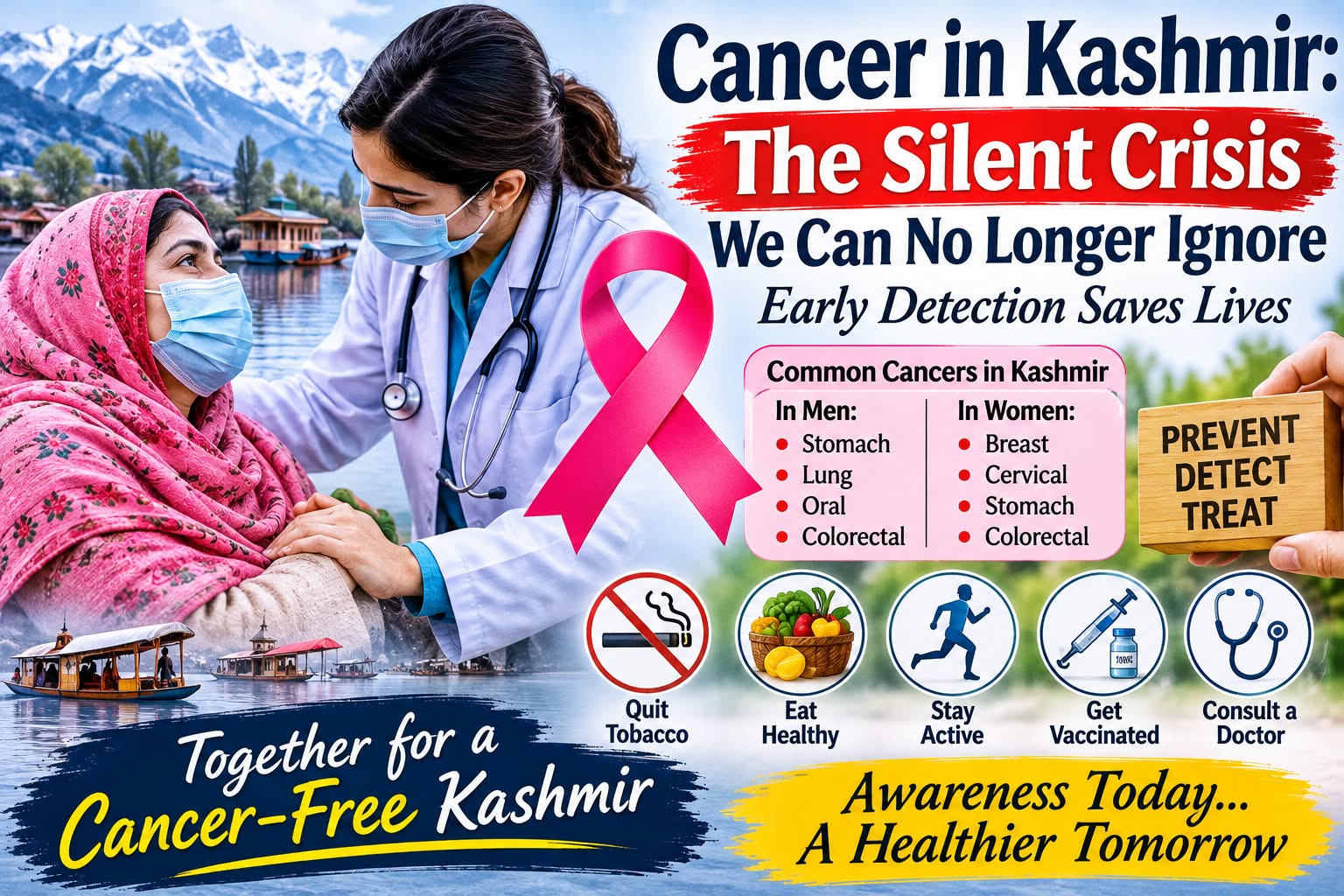
Research conducted in Kashmir has drawn particular attention to cancers affecting the digestive system. A study published in 2023 analysed 5,392 malignancy cases recorded at a major tertiary-care institute between 2016 and 2020. Gastrointestinal cancers accounted for more than one-third of the cases examined. Stomach cancer was the most frequent site among men in that study, followed by lung and colorectal cancers. Among women, breast cancer was the leading site, followed by colorectal and stomach cancers. Because the study examined patients at a particular institute, its findings should not be interpreted as an exact ranking for every person living in the Valley.
More recent research has also examined stomach cancer specifically. A 2025 study analysed 5,554 recorded cases from Kashmir spanning 2014 to 2023 and reported an increasing trend in the data examined, with more cases among men and the highest incidence in the 60–79 age group. The researchers also identified geographical variations. Such findings make continued research important, but they do not establish that every district has the same risk or identify one single cause of the disease.
Among men, stomach and lung cancers deserve particular attention in the context of these regional studies. Oral cancer is another important concern, especially because tobacco use in various forms is a recognised risk factor for cancers of the mouth and several other organs. Among women, breast cancer remains a major concern, while stomach and colorectal cancers also require attention. Cervical and ovarian cancers are important women’s health issues as well. The exact ranking of cancer types can differ according to the population, study period and data source, so claims about the most common cancers should always be supported by the relevant registry or research.
Why might stomach and other digestive cancers be a concern in Kashmir? Scientists have examined several possible contributors, including dietary patterns, tobacco exposure, infections and environmental factors. Infection with Helicobacter pylori, a bacterium that can cause chronic stomach inflammation and ulcers, is an established risk factor for stomach cancer. However, infection does not mean that a person will inevitably develop cancer. The relationship between food habits and cancer is also complex; no single traditional food should be declared the cause of cancer without convincing evidence. Further local research is needed to understand how different risk factors interact in the Kashmiri population.
A significant international finding published in 2026 offers another reason for hope. The World Health Organization and the International Agency for Research on Cancer estimated that 37 per cent of new cancer cases worldwide in 2022 were linked to preventable causes. The analysis considered 30 risk factors, including tobacco, certain infections, excess body weight, physical inactivity and air pollution. Tobacco was the leading preventable contributor globally. This estimate does not mean that 37 per cent of cancer cases in Kashmir are preventable, but it demonstrates the potential impact of evidence-based prevention.
Early detection is equally important. Persistent difficulty swallowing, unexplained weight loss, a lasting change in bowel habits, blood in the stool, a persistent cough, coughing up blood or a sore in the mouth that does not heal should not be ignored. For women, a new breast lump, unusual nipple discharge or unexplained vaginal bleeding requires medical assessment. These symptoms can have causes other than cancer, but persistent or unexplained changes deserve attention. People should consult qualified healthcare professionals rather than trying to diagnose themselves or relying on unverified remedies.
Prevention must begin in everyday life. Avoiding tobacco in all forms, maintaining a healthy weight, staying physically active, eating a balanced diet and following appropriate vaccination advice can help reduce the risk of certain cancers. Human papillomavirus vaccination can protect against infections responsible for most cervical cancers, while hepatitis B vaccination helps prevent hepatitis B infection, which can lead to liver cancer. Eligibility and vaccination schedules should be discussed with a healthcare professional. Screening can also help detect certain cancers before symptoms develop, but the appropriate tests depend on a person’s age, sex, risk factors and local medical guidance. Screening and diagnostic testing are not the same: a person with concerning symptoms should seek medical assessment without waiting for a routine screening appointment.
Kashmir also needs to address the emotional and financial burden of cancer. Fear of a diagnosis, social stigma, travel difficulties and treatment expenses may delay medical care. Families should encourage patients to seek help early and support them throughout treatment. No patient should be blamed for becoming ill, and no one should be made to feel ashamed of a cancer diagnosis. Public awareness campaigns must replace myths with accurate information and make clear that cancer is not one single disease: different cancers have different causes, treatments and outcomes.
The way forward requires coordinated action. Health authorities, hospitals, researchers, schools, community organisations and families all have a role in improving awareness, strengthening cancer registration, supporting research and making appropriate diagnostic and treatment services more accessible. Better data are especially important because accurate information about cancer types, age groups, sex and geographical distribution can help policymakers identify needs and plan services.
Cancer is a serious challenge, but it should not be surrounded by silence or hopelessness. Many cancers can be treated successfully, particularly when detected early, although outcomes depend on the cancer type, stage and availability of appropriate treatment. Kashmir needs greater awareness, stronger prevention efforts, dependable research and compassionate care for every patient. The fight against cancer does not begin only in an operating theatre or a chemotherapy unit. It begins when people recognise warning signs, seek reliable medical advice and support one another in taking action.
For Kashmir, awareness is not merely information—it is an opportunity to prevent avoidable illness, find cancer earlier and give more families a reason to hope.