
Mir Masroor ([email protected])
Kashmir is grappling with a drug menace of alarming proportions. While the causes are many and complex, one root cause remains largely unexamined — the burden we, as parents and teachers, unknowingly place on the shoulders of our young ones. Before we point fingers at dealers or blame the streets, we must look inward and honestly ask: Are we, in our own homes and classrooms, planting the seeds of hopelessness?
The Pressure We Call Love
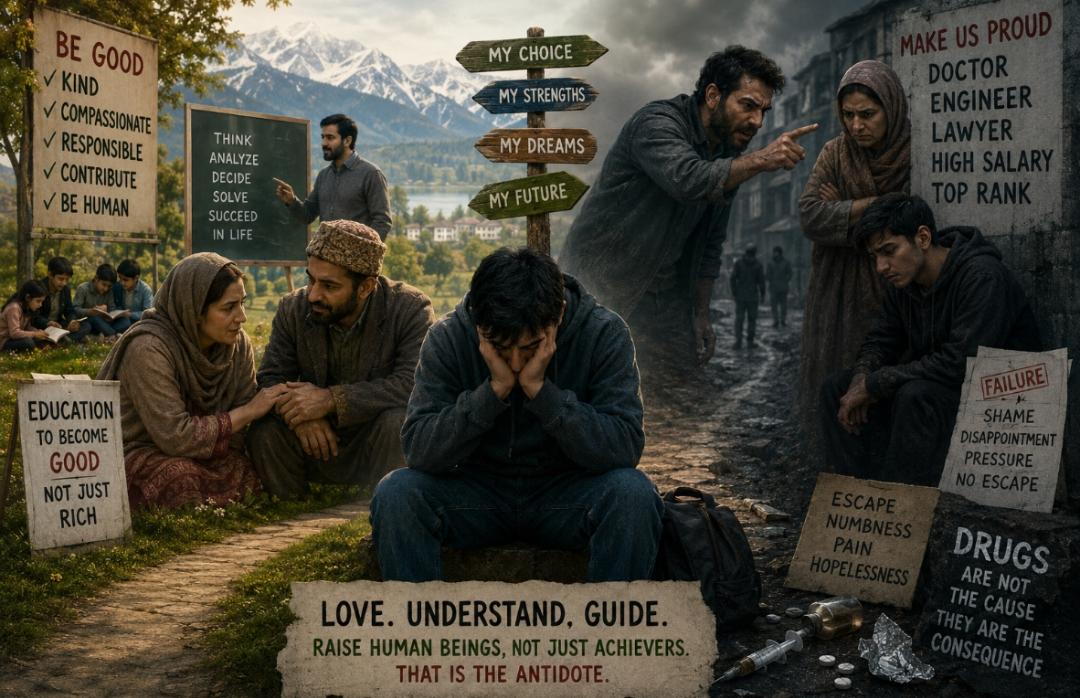
From the very first day a child enters school, a narrative is set in motion. Parents and teachers, with the best of intentions, begin feeding young minds a singular idea: education exists to make you a doctor, an engineer, or a lawyer. Success, in our collective imagination, has been reduced to a job title and a salary. We compare our children with those who have “made it” — who have secured high-paying positions and, in doing so, fulfilled the dreams of their elders. We invest in their schooling with a quiet expectation of returns: that one day, our children will rise to the heights we envisioned for them.
But in all of this, we rarely pause to ask the child: What do you want?
The dreams we impose are our own. The ambitions we chase through our children are, more often than not, the ambitions we ourselves could not fulfil. We set goals without first assessing whether our child has the aptitude, temperament, or passion for the path we have chosen. And yet, we push. We compare. We pressurise.
When Dreams Become a Burden
When a young student, carrying the enormous weight of parental expectation, fails to achieve the goal that was never truly his own, something breaks inside him. He does not want to disappoint the people he loves most. He feels trapped between the life he is expected to live and the life he is actually capable of living. In this suffocating space, with no tools to cope and no permission to fail, he searches desperately for an escape.
For many of Kashmir’s youth, that escape arrives in the form of a substance. Drugs offer, at least momentarily, what life seems to deny them — relief, numbness, and a temporary peace of mind. Unable to face failure, unable to speak openly of his pain, and unable to see any other way forward, the young person turns either inward in self-destruction or, in the most tragic cases, considers ending his life altogether. The drug, in this context, is not the beginning of the problem. It is the consequence of one.
A Gap in How We Teach
Alongside the pressure of expectations, there is a deeper educational failure at work. Our schools, by and large, continue to measure students by their ability to memorise and reproduce — marks on a paper, ranks in a class. But real life does not operate this way. Real life demands something our classrooms rarely develop: the ability to think critically, to weigh options, and to make sound decisions in the face of uncertainty.
Decision-making is not a luxury skill. It is a survival skill. When a young person has never been taught how to navigate failure, how to assess a difficult situation, or how to think through consequences, he is left defenceless when life does not go according to plan. Teachers have an enormous responsibility here — not merely to deliver curriculum, but to equip students with the mental and emotional tools they will need long after the classroom is behind them. Critical thinking, problem-solving, and resilience must be woven into education, not treated as extras.
A Different Kind of Education
The solution begins with a fundamental shift in how we define the purpose of education. We must move away from the idea that a child goes to school to become rich, and toward the belief that a child goes to school to become good.
Parents must give their children the freedom to discover their own strengths, follow their own interests, and set their own goals. Rather than measuring children against others, let us encourage them to measure themselves against their own potential. Rather than teaching them to chase wealth, let us teach them to cultivate health, kindness, and inner contentment. Let us raise children who know how to be decent human beings — who are compassionate, who contribute to their communities, and who find meaning in something beyond a pay cheque.
When a young person is grounded in strong human values, equipped with the skills to face adversity, and freed from the crushing weight of unrealistic expectations, he is far less likely to feel trapped. He is far less likely to seek escape in a needle or a pill.
A Shared Responsibility
The drug crisis in Kashmir will not be solved by law enforcement alone. It requires a cultural shift — in our homes, in our schools, and in our collective understanding of what it means to succeed. Parents and teachers must work together to dismantle the narrative that ties a child’s worth to his marks or his profession. In its place, we must build something more enduring: young people who are emotionally resilient, morally rooted, and capable of facing life on its own terms.
The antidote to despair is not found in a syringe. It is found in the quiet confidence of a child who knows he is loved, not for what he will become, but for who he already is.